A new bulge in the groin or abdomen can be easy to dismiss, especially when it causes little pain. But when that bulge grows, becomes uncomfortable, or starts interfering with exercise and everyday activities, it may be time for a closer look.
An inguinal or ventral hernia occurs when tissue protrudes through a weakened area or defect in the abdominal wall. The location helps determine the type of hernia, but symptoms, progression, and individual circumstances also matter when deciding what to do next.
At Yoshida Surgery in Orange, California, board-certified general surgeon Dr. Miya Yoshida evaluates groin and abdominal wall hernias and discusses appropriate management and surgical options when treatment is indicated.
Inguinal vs. Ventral Hernias: What Is the Difference?
Inguinal and ventral hernias affect different areas of the abdominal wall. Understanding where each develops can make symptoms easier to recognize.
Inguinal Hernias
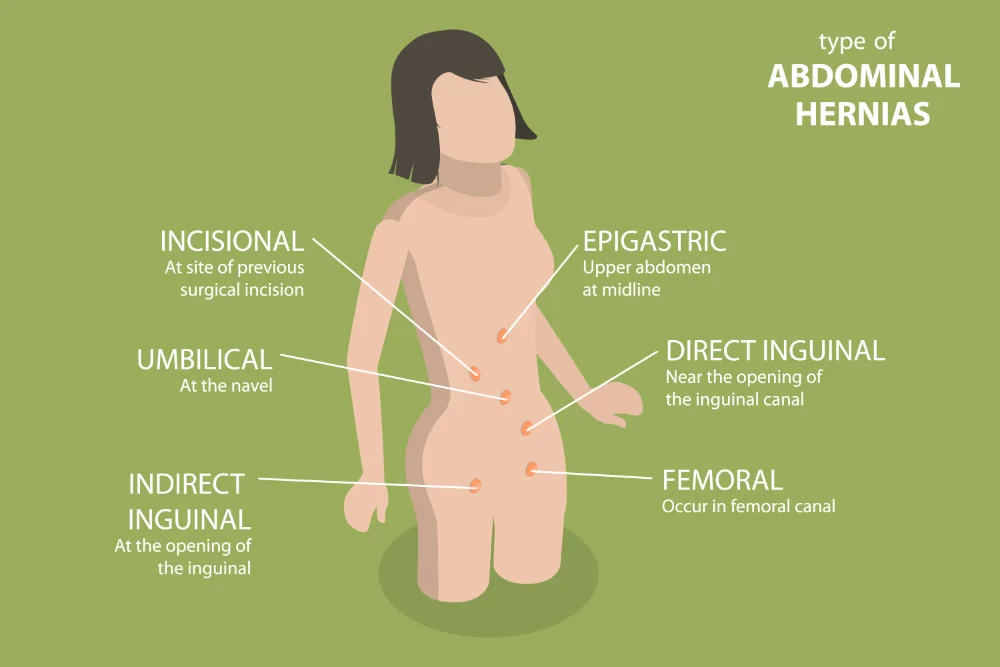
An inguinal hernia develops in the lower abdomen or groin near the inguinal canal. Patients may notice a bulge along with aching, burning, pressure, or heaviness that becomes more noticeable when standing, coughing, lifting, exercising, or straining.
Inguinal hernias may be classified as direct or indirect. A direct inguinal hernia develops through a weakened area of the abdominal wall, while an indirect inguinal hernia follows the pathway of the inguinal canal.
If repair is appropriate, the surgical approach depends on the characteristics of the hernia and the patient’s individual circumstances.
Ventral Hernias
A ventral hernia develops through a weakness or defect in the front of the abdominal wall. Common types include umbilical, epigastric, and incisional hernias.
Umbilical hernias occur around the belly button, while epigastric hernias develop along the upper middle abdomen. Patients may notice a visible bulge, localized discomfort, tightness, or pressure that becomes more noticeable with activity.
An incisional hernia develops at or near a previous abdominal surgical incision. Although the incision may appear healed externally, deeper abdominal wall tissue can remain vulnerable. Over time, weakened tissue can allow abdominal contents to protrude through the area.
When Should You See a Hernia Specialist?
Seeing a surgeon for a hernia evaluation does not automatically mean you need surgery. A consultation helps determine what type of hernia is present, whether it is changing, and whether observation or repair may be appropriate.
You Notice a New Bulge
An early hernia may appear as a soft bulge that becomes more noticeable when standing, coughing, lifting, or straining. It may become smaller or disappear when you lie down.
Even when there is little discomfort, an evaluation can confirm whether the bulge is a hernia and determine its location and characteristics.
Pain or Pressure Is Increasing
Some hernias gradually enlarge or become increasingly uncomfortable. Pain or pressure during walking, lifting, exercise, work, or other routine activities can be a reason to seek a surgical evaluation.
A previously diagnosed hernia should also be reassessed if it changes in size or begins interfering with activities that were previously comfortable.
The Hernia Is No Longer Reducible
A reducible hernia is one in which the protruding tissue can return to the abdominal cavity, either spontaneously or with gentle pressure. If a hernia that was previously reducible becomes firm or can no longer be pushed back, tissue may have become trapped.
This is known as incarceration and warrants prompt medical evaluation.
When Is a Hernia an Emergency?
Certain changes require urgent medical attention rather than waiting for a routine appointment.
Seek immediate medical care if a hernia is associated with:
- Sudden or severe pain
- A firm bulge that cannot be pushed back
- Red or purple discoloration over the hernia
- Nausea or vomiting
- Fever with worsening hernia symptoms
An incarcerated hernia occurs when tissue becomes trapped within the defect. If the blood supply to that tissue becomes compromised, the hernia may become strangulated. Strangulation is a surgical emergency.
Not every painful hernia is strangulated, but sudden or significant changes should not be ignored.
Does Every Hernia Need Surgery?
Not necessarily. A hernia is a structural defect and generally does not close on its own, but that does not mean every diagnosed hernia requires immediate repair.
Some hernias may be monitored when symptoms are limited, and observation is considered appropriate. Others may be better addressed with elective surgery when they enlarge, become increasingly symptomatic, or begin interfering with normal activities.
A surgical evaluation can help determine which approach makes sense based on the type of hernia, symptoms, progression, and individual circumstances.
How Are Inguinal and Ventral Hernias Repaired?
Hernia surgery is not one standard procedure. Depending on the location and complexity of the hernia, previous abdominal surgery, and individual anatomy, Dr. Yoshida may consider an open, laparoscopic, or robotic approach.
Robotic Hernia Repair
Robotic-assisted surgery uses small incisions and articulated instruments that allow the surgeon to work within the abdomen while viewing the surgical area in detail.
The robotic platform can assist with visualization, dissection, suturing, and mesh placement during selected repairs. Whether robotic surgery is appropriate depends on the type, size, location, and complexity of the hernia.
Laparoscopic Hernia Repair
Laparoscopic repair also uses small incisions, along with a camera and specialized surgical instruments.
For selected patients, it provides a minimally invasive approach to hernia repair. Previous surgery, anatomy, and the characteristics of the hernia all influence whether laparoscopic treatment is appropriate.
Open Hernia Repair
Open surgery remains an appropriate option for certain hernias and allows direct access to the affected area through an incision near the hernia.
The choice between open, laparoscopic, and robotic repair should be based on the individual hernia rather than assuming one technique is preferable for every patient.
Also Read: What Is General Surgery? Common Procedures and Benefits of Minimally Invasive Care
Is Mesh Always Used During Hernia Surgery?
Mesh may be used to reinforce a weakened area of the abdominal wall and provide structural support. Whether it is recommended, as well as its type and placement, depends on the hernia and surgical approach.
During a consultation, Dr. Yoshida can explain the proposed repair and discuss the potential benefits, risks, and alternatives based on the individual case.
What Happens During a Hernia Consultation?
Dr. Yoshida begins by evaluating the location, size, symptoms, and characteristics of the suspected hernia. Depending on the findings, diagnostic imaging such as ultrasound or CT may be recommended.
If a hernia is confirmed, treatment planning considers its size and location, current symptoms, previous abdominal surgery, and other patient-specific factors. Observation may be appropriate in some situations. When surgery is recommended, the next decision is whether an open, laparoscopic, or robotic repair is appropriate.
What Is Recovery Like After Hernia Surgery?
Recovery varies with the type of hernia, complexity of the repair, surgical approach, and individual healing.
Many minimally invasive hernia procedures can be performed on an outpatient basis, allowing patients to return home the same day when appropriate. Temporary discomfort is expected after surgery, followed by a gradual return to normal activities.
Work, lifting, exercise, and other activity restrictions vary. Dr. Yoshida provides postoperative instructions based on the specific repair rather than applying the same recovery timeline to every patient.
Hernia Care With Dr. Miya Yoshida in Orange County
Dr. Miya Yoshida is a board-certified general surgeon with fellowship training in advanced robotic, laparoscopic, and complex abdominal wall repair.
At Yoshida Surgery, we evaluate each hernia individually. When surgery is appropriate, the treatment plan considers the hernia’s location and characteristics, previous surgical history, anatomy, symptoms, and other relevant clinical factors.
Yoshida Surgery sees patients in Orange, California, and serves surrounding Orange County communities, including Irvine, Anaheim, Santa Ana, and Villa Park.
Schedule a Hernia Evaluation at Yoshida Surgery
A new groin or abdominal bulge does not automatically mean surgery is necessary. However, an evaluation becomes more important when symptoms are changing, the bulge is enlarging, or the hernia begins interfering with normal activities.
At Yoshida Surgery in Orange, Dr. Miya Yoshida evaluates inguinal, ventral, and incisional hernias and discusses management based on the individual diagnosis. Contact us to schedule a consultation to determine whether observation, elective repair, or another next step is appropriate.